
The learning goal
Children distinguish something directly observed from an idea about what it might mean, and give a reason for one inference.
What you need
One clean sock, a chair and a sheet of paper. Use an adult-drawn version or describe the same scene if objects are unavailable. No child needs to touch the sock.
Before children join
Put one sock on the chair seat, with one sheet of paper underneath it. Show everyone the arrangement or draw it clearly. Do not add other objects. Read the cards aloud so decoding is not a barrier.
Let’s try it
0–2 min · Meet the mystery
Introduce the sock as ‘our extremely quiet visitor.’ Ask children what they can see. Model: ‘The sock is on the chair’ is an observation.
2–5 min · Try an idea
Say: ‘Someone may have put it there to dry.’ Explain that this is an inference, an idea about the scene. We did not see someone do that.
5–10 min · Sort together
Read the six cards. Children point to ‘We can observe it’ or ‘We are explaining it,’ or sort with a partner. Discuss the reason rather than racing.
10–13 min · Invent, then check
Invite a wonderfully silly explanation. Ask whether the scene gives us a reason to believe it. Enjoy the invention while keeping pretend stories distinct from supported conclusions.
13–15 min · One of each
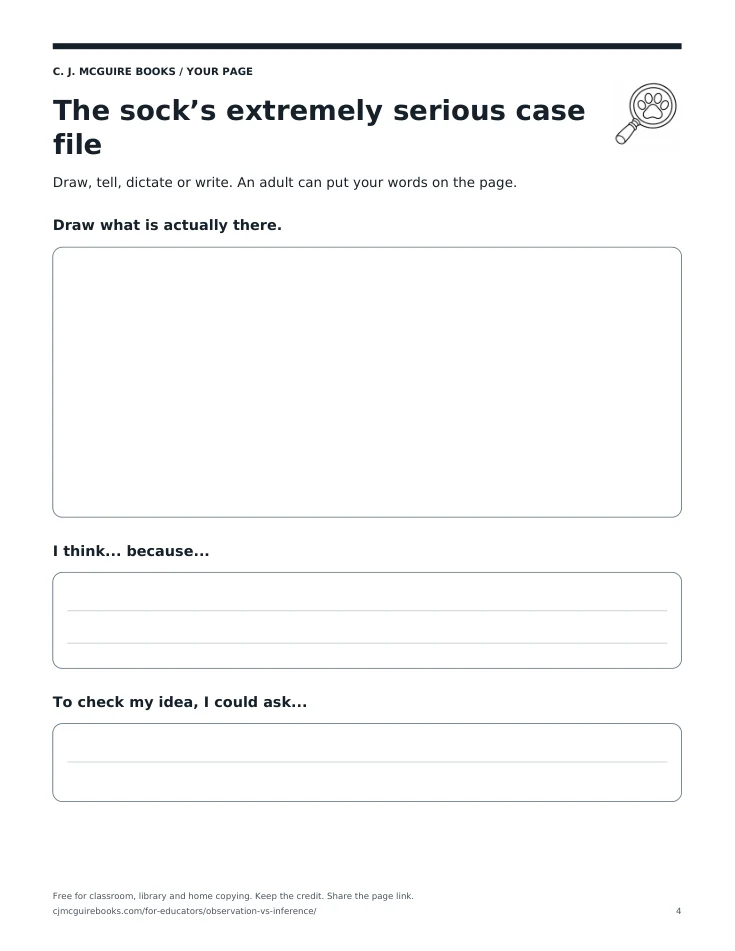
Each child draws or tells one observation and one possible explanation. Ask what else they would need to know to check it.
We can observe it / We are explaining it
Read these straight from the screen, copy them onto scrap paper, or use page 3 of the PDF.
A sock is on the chair.
Someone forgot the sock.
Paper is under the sock.
The sock is there to dry.
There is one sock.
Someone will put the sock on soon.
A model / what to listen for
Cards 1, 3 and 5 are observations of the setup: a sock on a chair, paper underneath it, and one sock. Cards 2, 4 and 6 are inferences about why it is there or what may happen. ‘Someone forgot it’ is possible, but the objects alone do not establish that.
Make room for your group
Keep only two cards at first. Pair a spoken label with a point or object. Offer ‘I see…’ and ‘I think…’ sentence starters. A child can direct an adult to move a card.
Ask which inference is plausible and what information would help check it. Then change one visible detail and have children update only the observation that changed.
A child can draw, dictate, point, sign or use familiar communication supports. Offer seated and quiet ways to join, and a choice to pass. An adult can read every prompt aloud.
A quick check for understanding
Can the child show which part can be directly observed and which part explains it? Naming the categories matters less than explaining the difference in their own way.
No printer? Still works.
Place two pieces of paper on the table as sorting spaces. Read the cards from this page and let children point, gesture or tell you their choice.
A little invitation for home
A grown-up chooses one everyday object. Name one thing you can observe and two things you wonder about it.
One clue explained in a child’s own way is worth noticing. Thank you for making space for their thinking.
A few useful details
Copy these original resources freely for noncommercial classroom, library and home use, including a closed class learning platform. Keep the credit and website link. To share publicly, link to the resource page. You do not need a C. J. McGuire book to use these activities.
How these resources were made
Creative direction is by C. J. McGuire. The resources were developed with AI assistance and are offered for educator review. They have not been independently evaluated or mapped to curriculum standards. The teaching notes describe intended practice, not promised outcomes.
The reading activities draw on principles such as modeling comprehension strategies and purposeful discussion. The IES guide to K–3 reading comprehension explains the evidence and its different strengths. It does not evaluate these resources.
Tell C. J. what worked, what needed help, or ask about a school or library reading → General observations are enough; please do not send children’s names, photographs or identifiable work.
Keep the wondering going.
These activities come from the story world of C. J. McGuire Books. My Dad the Werewolf is coming soon: two children, one very shaggy dad, and a theory worth investigating.
Optional book news → The resources stay free either way.