
The learning goal
Children use two clues to choose a plausible location and explain how new information changed or strengthened their idea.
What you need
One scrap of paper marked STAR, one picture book, one empty folder and one pencil box. All three possible hiding places should be able to open. Optional clue cards and pencils.
Before children join
Before the session, put the paper STAR between two pages of the book. Place the book, empty folder and pencil box where everyone can see them. Tell children this is a pretend puzzle you set up. Keep the three clue cards in order and the solution separate.
Let’s try it
0–3 min · Open the case
Explain: ‘Our paper story star is in one of these three places. It left us clues.’ Name and show the book, empty folder and pencil box. Let everyone make a private first guess.
3–7 min · Clue one
Read: ‘I am inside something you can open.’ All three places still fit. Ask ‘Do we know enough yet?’ Keep more than one possibility alive.
7–12 min · Clue two
Read: ‘There are pages on both sides of me.’ Partners reconsider. Ask which location now fits better and which words helped them.
12–16 min · Clue three and reveal
Read: ‘I am keeping your place for the next story.’ Invite a final explanation, then open the book to reveal the paper. Give the star’s message: ‘I am a bookmark. Important work. Excellent naps.’
16–20 min · Explain the change
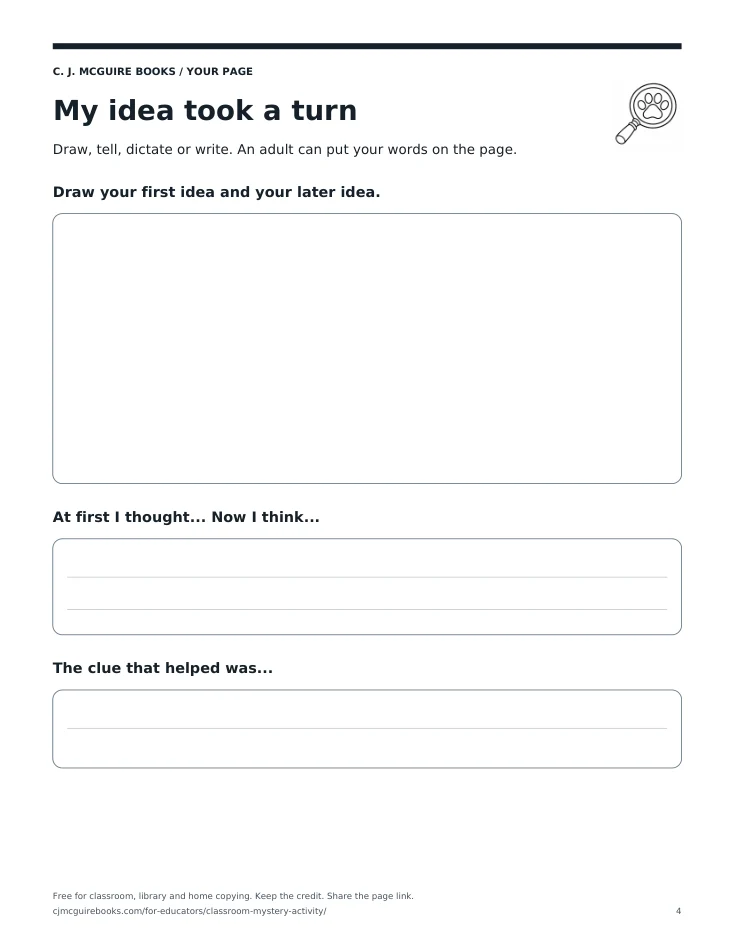
Children record a first idea and a later idea, or tell them to a partner. Ask which clue changed or confirmed their thinking. Finish by inventing a new job for the star.
Read one clue at a time
Read these straight from the screen, copy them onto scrap paper, or use page 3 of the PDF.
I am inside something you can open.
There are pages on both sides of me.
I am keeping your place for the next story.
A model / what to listen for
The book is the intended solution. Clue one alone does not distinguish the three places. Clue two points to the book because the folder is empty and the pencil box contains no pages. Clue three supports its new job as a bookmark. If your setup differs, accept alternatives that fit and fix the setup for next time.
Make room for your group
Keep all objects visible and describe their important features aloud. Read each clue twice. Children can point to a location, direct a partner, sign, draw or use familiar communication supports. No searching around the room is required.
Invite children to design a fair new clue for a different hiding place. Test whether it eliminates every wrong option; revise clues that accidentally fit more than one place.
A child can draw, dictate, point, sign or use familiar communication supports. Offer seated and quiet ways to join, and a choice to pass. An adult can read every prompt aloud.
A quick check for understanding
Ask ‘Why the book?’ A response that refers to pages or keeping a reading place shows a clue-to-explanation connection. Finding the star without a reason is a prompt for another conversation, not a failure.
No printer? Still works.
Write STAR on scrap paper and read clues from this page. Without props, draw and label the three places on a board and tell the same puzzle aloud.
A little invitation for home
A grown-up puts a paper star in a safe, reachable place. Give one broad clue and one more specific clue. Trade jobs.
One clue explained in a child’s own way is worth noticing. Thank you for making space for their thinking.
A few useful details
Copy these original resources freely for noncommercial classroom, library and home use, including a closed class learning platform. Keep the credit and website link. To share publicly, link to the resource page. You do not need a C. J. McGuire book to use these activities.
How these resources were made
Creative direction is by C. J. McGuire. The resources were developed with AI assistance and are offered for educator review. They have not been independently evaluated or mapped to curriculum standards. The teaching notes describe intended practice, not promised outcomes.
The reading activities draw on principles such as modeling comprehension strategies and purposeful discussion. The IES guide to K–3 reading comprehension explains the evidence and its different strengths. It does not evaluate these resources.
Tell C. J. what worked, what needed help, or ask about a school or library reading → General observations are enough; please do not send children’s names, photographs or identifiable work.
Keep the wondering going.
These activities come from the story world of C. J. McGuire Books. My Dad the Werewolf is coming soon: two children, one very shaggy dad, and a theory worth investigating.
Optional book news → The resources stay free either way.