
The learning goal
Children identify one visible detail, offer an explanation that fits it, and consider another possibility.
What you need
One picture-book illustration with something to wonder about, a sheet of paper to cover part of it, and optional pencils. Use a book you already have; no particular title is required.
Before children join
Choose a picture where an action or feeling can be inferred from at least two visible details. Preview it first. Teach any essential unfamiliar word before asking children to reason. Keep the story text available for the final check.
Let’s try it
0–3 min · Notice
Show the whole illustration. Give everyone quiet looking time, then ask: ‘What can you point to that is actually in the picture?’ Name two details without explaining them yet.
3–6 min · Model
Say: ‘I notice ___. I know ___. So I think ___ might be happening.’ Explain that an inference is an idea built from clues and what we know, and that it can change.
6–11 min · Make a case
Partners choose a detail and offer an explanation. Ask ‘What in this picture makes you think that?’ Accept different ideas that fit the available evidence.
11–15 min · Zoom out
Cover all but one detail, then reveal the full picture again. Does the extra information change anyone’s idea? Read the accompanying text and compare it with the ideas.
15–20 min · Show your thinking
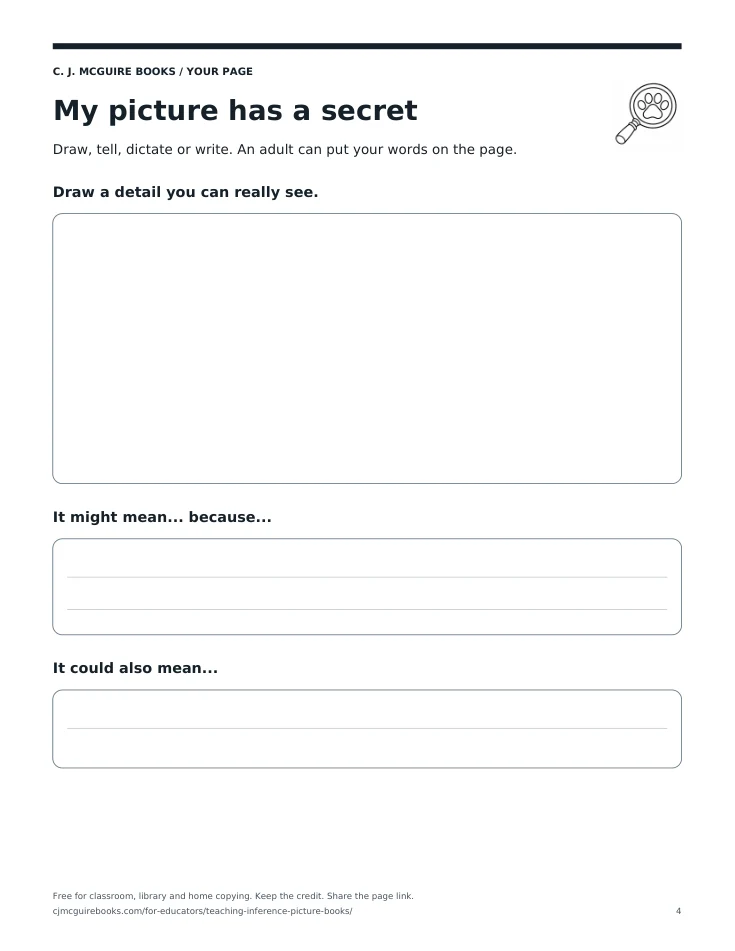
Children use the detective page or tell you one clue and one possible explanation. Finish with a new picture detail: can they use the same routine without your full model?
The detective’s three moves
Read these straight from the screen, copy them onto scrap paper, or use page 3 of the PDF.
I can point to…
I know… so it might mean…
Another idea is… What else would help us decide?
A model / what to listen for
If a picture shows an open umbrella and drops on a coat, ‘It may be raining’ fits those details. ‘It is Tuesday’ is not supported by that picture. A wet coat could have another explanation; check the surrounding text before settling it.
Make room for your group
Kindergarten or children needing a smaller step: offer two spoken possibilities, model the important vocabulary, and let a child point while an adult records their explanation. Use familiar experiences instead of assuming everyone shares the same background knowledge.
Grades 1–2 when ready: ask for two clues, a second possible explanation and one piece of information that would help decide. Separate an inference about now from a prediction about what happens next.
A child can draw, dictate, point, sign or use familiar communication supports. Offer seated and quiet ways to join, and a choice to pass. An adult can read every prompt aloud.
A quick check for understanding
Listen for a connection between a visible detail and an idea. A child who gives only a guess gets ‘Which part helped you?’ A child who names only a detail gets ‘What might that mean?’
No printer? Still works.
Use one projected picture, an adult’s book or a shared drawing. Children point, tell, sign or use their familiar communication supports; the worksheet is optional.
A little invitation for home
Find a picture at home. Each person names one detail and one idea it suggests. Can the same detail support two ideas?
One clue explained in a child’s own way is worth noticing. Thank you for making space for their thinking.
A few useful details
Copy these original resources freely for noncommercial classroom, library and home use, including a closed class learning platform. Keep the credit and website link. To share publicly, link to the resource page. You do not need a C. J. McGuire book to use these activities.
How these resources were made
Creative direction is by C. J. McGuire. The resources were developed with AI assistance and are offered for educator review. They have not been independently evaluated or mapped to curriculum standards. The teaching notes describe intended practice, not promised outcomes.
The reading activities draw on principles such as modeling comprehension strategies and purposeful discussion. The IES guide to K–3 reading comprehension explains the evidence and its different strengths. It does not evaluate these resources.
Tell C. J. what worked, what needed help, or ask about a school or library reading → General observations are enough; please do not send children’s names, photographs or identifiable work.
Keep the wondering going.
These activities come from the story world of C. J. McGuire Books. My Dad the Werewolf is coming soon: two children, one very shaggy dad, and a theory worth investigating.
Optional book news → The resources stay free either way.