
Your first 20 minutes, sorted.
Goal: connect a character’s want and problem to a voice, picture or story choice, then explain that choice.
Gather: pencils and plain paper or the pages below. You can read every line aloud. A familiar picture book is optional; the workbook includes an original tiny skit.
0–3 min · Make the invitation
“We’re making stories. You can speak, draw, direct, point or watch. We laugh at the silly situation, not at one another. You can change your job.” Model a quiet option before beginning.
3–7 min · Give one line a character
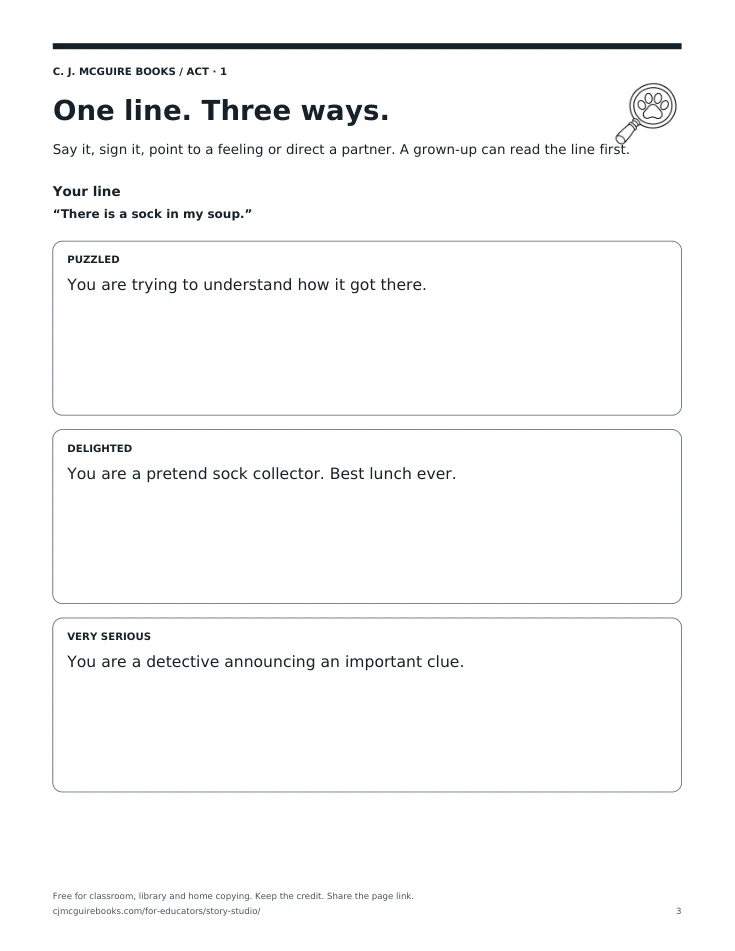
Read “There is a sock in my soup.” Try puzzled, delighted and very serious. Ask which choice makes the listener imagine the character differently, and why. Change pace or expression without making the sound louder.
7–15 min · Choose one making job
Act the original “Sock Inspector” skit on page 5; draw the three-picture sequence on page 7; or plan a character’s problem and solution on page 11. Let pairs share a job. Model one small beginning, then hand the decisions to children.
15–20 min · Share a choice
Invite a volunteer to say, point or dictate: “I chose ___ because ___.” Others can notice a specific choice. “You made the cook speak slowly when they saw the sock.” Keep public sharing optional.
Act a character, not an accent.
On pages 3–6, children explore pace, pauses, expression and what a character wants. They can echo an adult or perform with a partner. Voices should never imitate a classmate’s speech, disability, language or identity for a laugh.
Try the three-role “Sock Inspector.” The cook thinks a sock is in the soup. The inspector notices handles: this is a laundry basket! The basket’s performer may simply point to the handles. Ask which detail changes the explanation. A child can direct the reveal while an adult reads.
Make a film out of paper.
Pages 7–10 introduce visual storytelling without needing a device. A wide view shows the place, a medium view shows the character doing something, and a close-up shows the detail we need to notice.
Draw a kitchen, a cook looking into a basket, and a close-up of the sock. Does that sequence let a partner understand what happens? Rearrange or redraw if it does not. Add one comfortable sound or a silent gesture. That is a paper film.
If your school chooses to record a version, use school-approved equipment and permissions. Recording and public sharing are optional; this activity works fully on paper.
Write a book only they could make.
Pages 11–15 leave room for a character, a want, a problem, a try and an ending. Children draw, dictate or write. For example: a spoon wants to join a band, cannot blow a trumpet, and discovers it can tap a rhythm. The ending connects to the beginning.
Use a cover and three story pages, then staple only if an adult is handling the stapler. A stack of numbered sheets works too. Let children decide the title. “My Spoon Book” is a perfectly good start.
A crew with room for everyone.
Pages 17–20 practice inviting another character, sharing a job and setting a kind boundary through adult-led, fictional play. Nobody has to play an excluded child or a bully. Read the complete 15-minute kind-improv game →
Use the pages that fit today.
| If you want to… | Allow | |
|---|---|---|
| Try a voice or act a tiny scene | 3–6 | 10–15 min |
| Plan a paper film or short script | 7–10 | 15–25 min |
| Make a little book | 11–15 | 20 min; continue next session |
| Reflect on making together | 16 | 3–5 min |
| Try kind improv | 17–20 | 15 min |
Pages 1–2 are adult starting notes. In the kind-improv section, 17 and 19 are adult notes, 18 has phrase cards and 20 is a child’s response page.
A smaller step, or another stretch.
A smaller step: offer two pictures or two spoken choices; let a child point; draw the beginning together. Kindergarten writers may tell the story while you record it. Familiar signing or AAC belongs here too.
When ready: ask grades 1–2 writers to connect two events with “because” or “so,” revise a confusing picture, or explain why a close-up helps the audience understand the reveal. Do not use reading speed or public confidence as a measure of imagination.
Listen for: a reason for a character choice, events that connect, and a way a collaborator helped. If the ending feels unrelated, return to “What did your character want?”
A few useful details
Copy these original resources freely for noncommercial classroom, library and home use, including a closed class learning platform. Keep the credit and website link. To share publicly, link to the resource page. You do not need a C. J. McGuire book to use these activities.
How these resources were made
Creative direction is by C. J. McGuire. The resources were developed with AI assistance and are offered for educator review. They have not been independently evaluated or mapped to curriculum standards. The teaching notes describe intended practice, not promised outcomes.
The reading activities draw on principles such as modeling comprehension strategies and purposeful discussion. The IES guide to K–3 reading comprehension explains the evidence and its different strengths. It does not evaluate these resources.
Tell C. J. what worked, what needed help, or ask about a school or library reading → General observations are enough; please do not send children’s names, photographs or identifiable work.
Keep the wondering going.
These activities come from the story world of C. J. McGuire Books. My Dad the Werewolf is coming soon: two children, one very shaggy dad, and a theory worth investigating.
Optional book news → The resources stay free either way.