
The learning goal
Children retell a simple problem and solution, use a described detail to explain a choice, and invent a sensible or playfully impossible solution.
What you need
The three activity cards, plain paper and pencils or crayons. No costumes, food, special decorations or real pumpkin are needed.
Before children join
Choose one activity for a short session, or all three for a longer one. Read the pumpkin story aloud: ‘Pip the pumpkin wanted warm toes. Pip bought socks. Pip looked down. No toes! A friend made the socks into a scarf. Warm at last.’ For a fall-only version, replace Pip with a round pebble named Pip throughout.
Let’s try it
0–3 min · Hear the problem
Read the five-sentence story with a pause before ‘No toes!’ Invite a puzzled face or a quiet gesture, with listening-only participation welcome.
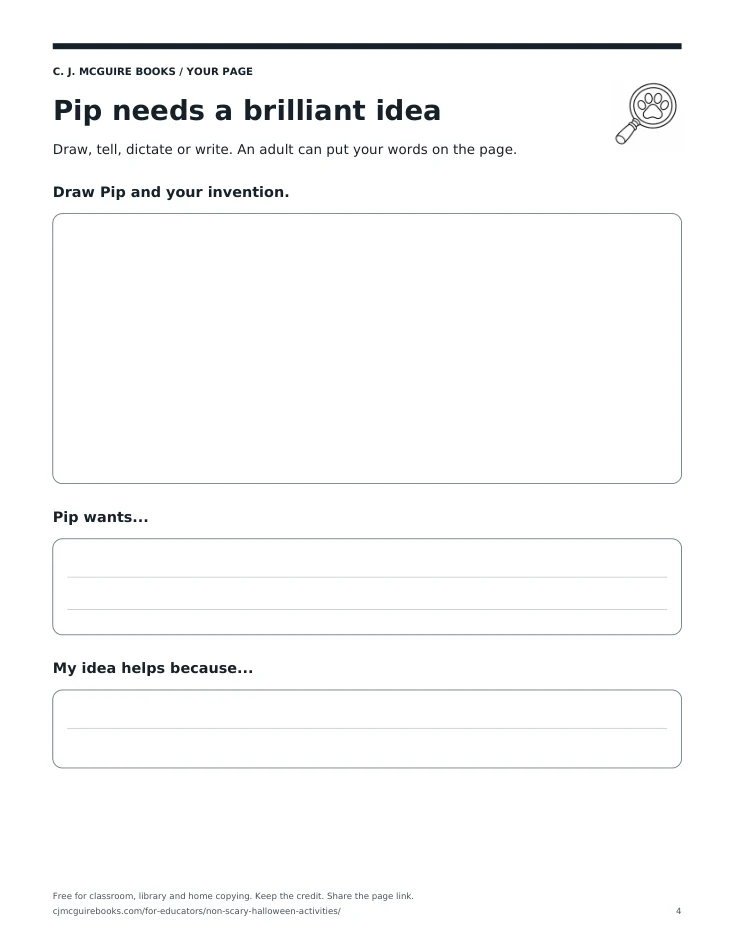
3–8 min · Activity 1: Help Pip
Children invent another use for the socks. Let them draw, dictate or demonstrate with their hands. Ask ‘How does your idea help Pip?’
8–13 min · Activity 2: Clue costume
Give three spoken clues: ‘It sits on a head. It keeps a head warm. It can have a pom-pom.’ Children suggest a hat and explain a clue. They invent a new three-clue object for a partner.
13–20 min · Activity 3: Tiny theater
Partners retell Pip’s problem, attempted solution and ending with three pictures or three still poses. Children can narrate while a partner points to pictures.
20–25 min · Share a solution
Invite two different solutions. Ask what stayed the same in the story and what the storytellers changed. A five-minute extension is optional.
Three little adventures
Read these straight from the screen, copy them onto scrap paper, or use page 3 of the PDF.
A pumpkin wants warm toes. There are no toes. Invent a way to help!
It sits on a head. It keeps a head warm. It can have a pom-pom. What could it be? Give a reason.
Show the problem, the try and the ending. Draw it, tell it or make three still poses.
A model / what to listen for
The story problem is wanting warmth without toes; the original solution is a scarf made from socks. A sock hat or blanket also addresses warmth. A rocket ride is a fun new story; ask how the child wants it to solve Pip’s problem rather than marking imagination wrong.
Make room for your group
Use the pebble version for a season-neutral activity. Offer a scarf and hat as spoken choices. An adult can describe pictures and record children’s ideas. Movement, costumes and monster voices are never required.
Children explain how their ending follows from the problem. Add a new complication, such as wind, then revise one scene rather than starting the entire story again.
A child can draw, dictate, point, sign or use familiar communication supports. Offer seated and quiet ways to join, and a choice to pass. An adult can read every prompt aloud.
A quick check for understanding
Ask for the problem and the solution in any communication mode. Can the child put the three events in order? For the clue game, listen for a relevant detail in their explanation.
No printer? Still works.
Read the story and cards from this page. Retell with fingers, three spoken sentences, shared board drawings or three quiet poses.
A little invitation for home
Choose an object that wants something silly. Tell its problem and invent a helpful ending together.
One clue explained in a child’s own way is worth noticing. Thank you for making space for their thinking.
A few useful details
Copy these original resources freely for noncommercial classroom, library and home use, including a closed class learning platform. Keep the credit and website link. To share publicly, link to the resource page. You do not need a C. J. McGuire book to use these activities.
How these resources were made
Creative direction is by C. J. McGuire. The resources were developed with AI assistance and are offered for educator review. They have not been independently evaluated or mapped to curriculum standards. The teaching notes describe intended practice, not promised outcomes.
The reading activities draw on principles such as modeling comprehension strategies and purposeful discussion. The IES guide to K–3 reading comprehension explains the evidence and its different strengths. It does not evaluate these resources.
Tell C. J. what worked, what needed help, or ask about a school or library reading → General observations are enough; please do not send children’s names, photographs or identifiable work.
Keep the wondering going.
These activities come from the story world of C. J. McGuire Books. My Dad the Werewolf is coming soon: two children, one very shaggy dad, and a theory worth investigating.
Optional book news → The resources stay free either way.