
The learning goal
Children create a short story with a character, a want or problem, and an ending connected to what came before.
What you need
One chosen prompt, pencils or crayons and the story sheet or plain paper. An adult or peer can write down a child’s dictated words.
Before children join
Offer two or three prompts rather than all twelve at once. Cards 1–6 are fall-only; cards 7–12 add gentle Halloween make-believe. Children may choose a familiar object instead of a seasonal character.
Let’s try it
0–3 min · Pick a problem
Read two prompts aloud. Children choose one, combine ideas or invent a different character. Ask ‘What does your character want?’
3–7 min · Tell it first
Partners tell a possible beginning and one thing that gets in the way. Model an attempt that does not quite work before the ending.
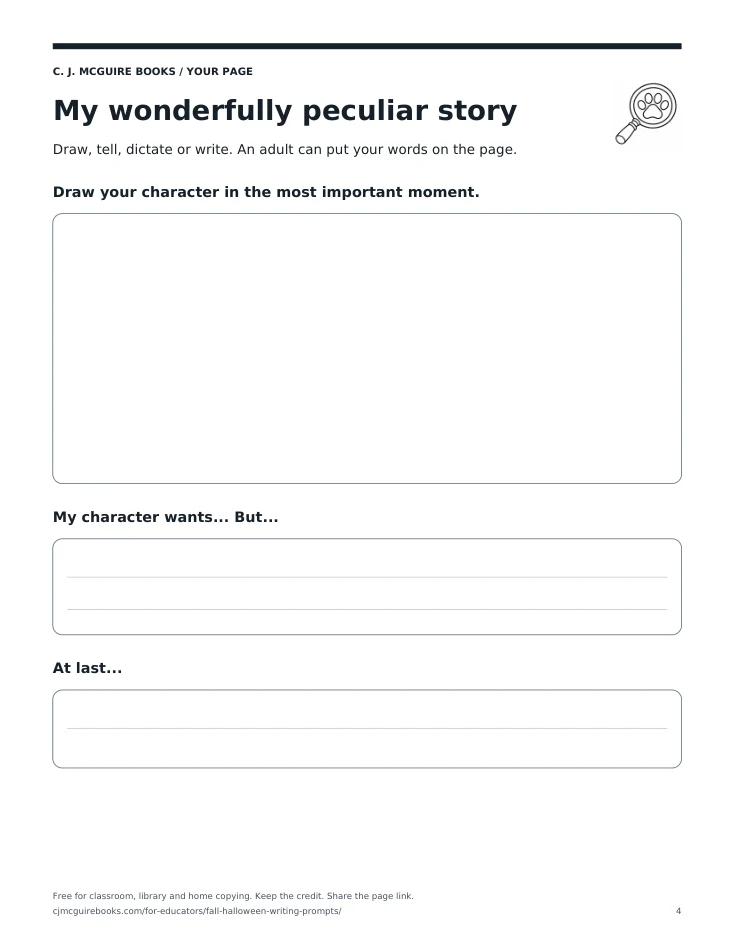
7–17 min · Make it
Children draw, dictate, write or arrange pictures. Use ‘First… Then… At last…’ if helpful. Focus on the story connection before spelling or neatness.
17–22 min · Try an audience
A partner points to or listens to the story. Ask ‘What was the problem? How did it end?’ The storyteller can add a missing detail.
22–25 min · Give it a title
Choose a title that makes someone curious. Invite a quiet gallery or an optional read-aloud. Save unfinished stories for another day.
Pick a problem. Surprise us.
Read these straight from the screen, copy them onto scrap paper, or use page 3 of the PDF.
A leaf refuses to fall. What is it waiting for?
A squirrel opens a lost-and-found for acorns.
A rain boot wants a dry-day adventure.
A scarecrow asks for a lunch break.
The wind delivers a letter to the wrong tree.
A puddle would like to see the sky up close.
A pumpkin wants pockets. What will it carry?
A friendly ghost is very bad at hide-and-seek.
A costume hat chooses a different job.
A tiny monster’s loudest roar sounds like a hiccup.
A pretend witch’s broom wants to sweep, not fly.
A skeleton starts a band but keeps losing a drumstick.
A model / what to listen for
Prompt: a leaf refuses to fall. One possible story: ‘Leaf wanted one more look at the sky. It held on while the other leaves drifted away. A breeze offered a flying tour. Leaf let go.’ This is one example, not an ending to copy or a required answer.
Make room for your group
Kindergarten: a drawing plus a dictated beginning and ending is enough. First grade when ready: one sentence per event with oral rehearsal. Accept invented spelling and provide a small word bank only when it helps the child’s chosen idea.
Second grade when ready: add dialogue, a second attempt or a surprising but connected ending. Ask which picture deserves a close-up and what extra detail it would show.
A child can draw, dictate, point, sign or use familiar communication supports. Offer seated and quiet ways to join, and a choice to pass. An adult can read every prompt aloud.
A quick check for understanding
Can the child identify what their character wants and explain how the ending connects? Ask a partner to retell it; use any confusion as a reason to add one useful detail.
No printer? Still works.
Fold one sheet into three spaces, use a shared board or record the story through adult scribing. Speaking, signing and arranging existing pictures count as composing.
A little invitation for home
Tell someone your beginning. Invite them to offer a silly middle, then choose your own ending.
One clue explained in a child’s own way is worth noticing. Thank you for making space for their thinking.
A few useful details
Copy these original resources freely for noncommercial classroom, library and home use, including a closed class learning platform. Keep the credit and website link. To share publicly, link to the resource page. You do not need a C. J. McGuire book to use these activities.
How these resources were made
Creative direction is by C. J. McGuire. The resources were developed with AI assistance and are offered for educator review. They have not been independently evaluated or mapped to curriculum standards. The teaching notes describe intended practice, not promised outcomes.
The reading activities draw on principles such as modeling comprehension strategies and purposeful discussion. The IES guide to K–3 reading comprehension explains the evidence and its different strengths. It does not evaluate these resources.
Tell C. J. what worked, what needed help, or ask about a school or library reading → General observations are enough; please do not send children’s names, photographs or identifiable work.
Keep the wondering going.
These activities come from the story world of C. J. McGuire Books. My Dad the Werewolf is coming soon: two children, one very shaggy dad, and a theory worth investigating.
Optional book news → The resources stay free either way.