
The small, useful goal
Children practice one invitation or helpful response and show how a pretend character can join while respecting another person’s choice. This is rehearsal for a skill, not a test of who is “nice.”
What you need
Paper and a pencil. Draw one moon bus and one new passenger. Children may make a still picture, direct an adult, speak, sign or use familiar communication supports. No acting experience, touching or moving around is required.
Agree on the crew rules
We laugh at the situation, not people. We ask before changing someone’s work. We can pass, watch or change jobs. The adult pauses the game if anyone becomes uncomfortable or the play turns unkind.
Your 15-minute moon trip
0–3 min · Model the invitation
Give the bus three pretend jobs: driver, map reader and door-sound designer. Several children can share any job, and quiet directing counts. Hold up your drawn new passenger: “This character wants to help. How could our crew make room?” Do not assign a child to be left out.
3–6 min · Borrow a phrase
Model “Would you like to read the map with me?” and “You can watch first.” Ask which gives the passenger a real choice. Let children select a phrase from the cards, or offer their own.
6–10 min · Play one tiny scene
Pairs direct the adult’s passenger or play two welcoming crew members. They try an invitation, then pause. The adult answers for the passenger: “I’d like to help, but I don’t want to make a sound.” Children try a quiet shared job. Twenty seconds of scene is plenty.
10–13 min · Give the scene another take
The adult narrates a fictional snag: “Our pretend map has only one name on it. Another character helped too.” Invite a response such as “Let’s make room for both names” or “Let’s ask the grown-up for help.” Do not act out name-calling or ask children to reenact an incident.
13–15 min · Notice one helpful choice
Ask: “What did someone say or do that gave the passenger a way to join?” Children tell, draw or point to a phrase. Finish with one choice the crew will keep: “We can share a job.” Passing on the reflection is fine too.
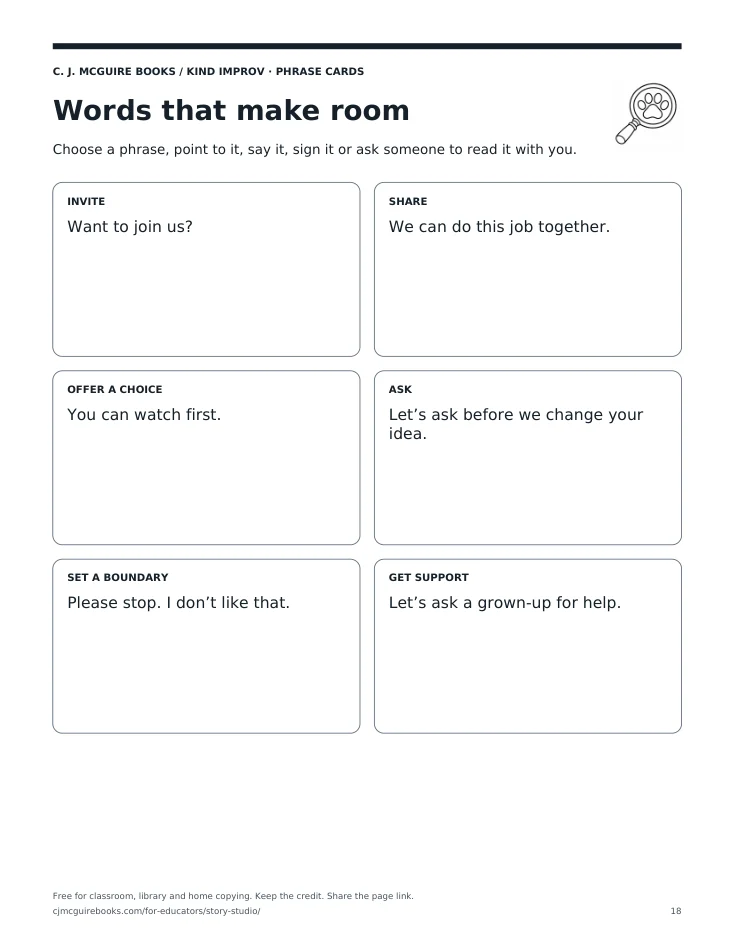
Six phrases to put to work
“Want to join us?”
“We can do this job together.”
“You can watch first.”
“Let’s ask before we change your idea.”
“Please stop. I don’t like that.”
“Let’s ask a grown-up for help.”
If the scene needs a reset
Someone laughs at a child: “Pause. That joke landed on a person. Let’s move the joke back to our very unusual bus.” Check in with the child; they may choose another role or stop.
A child says no: “They can say no. Let’s offer another way, or give them space.” Kindness does not mean agreeing to every idea, sharing every possession or accepting unwanted touch.
Two children want the same job: offer shared directing, two map readers or an adult-supported turn plan. Do not make children compete for the one valued role.
A real concern comes up: stop the activity and follow your school or library’s support procedures. Adults are responsible for responding to harm. A short improv game is not an anti-bullying intervention, and children should not be expected to manage unsafe behavior themselves.
Make it smaller or stretch it
Start with one adult puppet or drawing and two possible phrases. A child can point to the helpful invitation. When ready, ask children to explain why a phrase offers a choice, then try it in a new fictional setting: a cloud bakery or a library for sleepy dragons.
The useful check is specific: did the response offer a workable way in and respect the character’s answer? Avoid public ratings of kindness or asking children to name who is often left out.
At home, invite a grown-up to make room for one more toy in a pretend story. The toy can choose a quiet job.
A few useful details
Copy these original resources freely for noncommercial classroom, library and home use, including a closed class learning platform. Keep the credit and website link. To share publicly, link to the resource page. You do not need a C. J. McGuire book to use these activities.
How these resources were made
Creative direction is by C. J. McGuire. The resources were developed with AI assistance and are offered for educator review. They have not been independently evaluated or mapped to curriculum standards. The teaching notes describe intended practice, not promised outcomes.
The reading activities draw on principles such as modeling comprehension strategies and purposeful discussion. The IES guide to K–3 reading comprehension explains the evidence and its different strengths. It does not evaluate these resources.
Tell C. J. what worked, what needed help, or ask about a school or library reading → General observations are enough; please do not send children’s names, photographs or identifiable work.
Keep the wondering going.
These activities come from the story world of C. J. McGuire Books. My Dad the Werewolf is coming soon: two children, one very shaggy dad, and a theory worth investigating.
Optional book news → The resources stay free either way.