
THE RESOURCE LIBRARY · 10 MINUTES · PAPER + PENCILS
Make a tiny film. Leave the camera in the cupboard.
From C. J. McGuire Books · K–2, with an adult
Your film studio needs paper, pencils and a fairly unusual problem. Try this one: a cook has found a sock in the soup. Catering has some explaining to do.
Three pictures, one little story
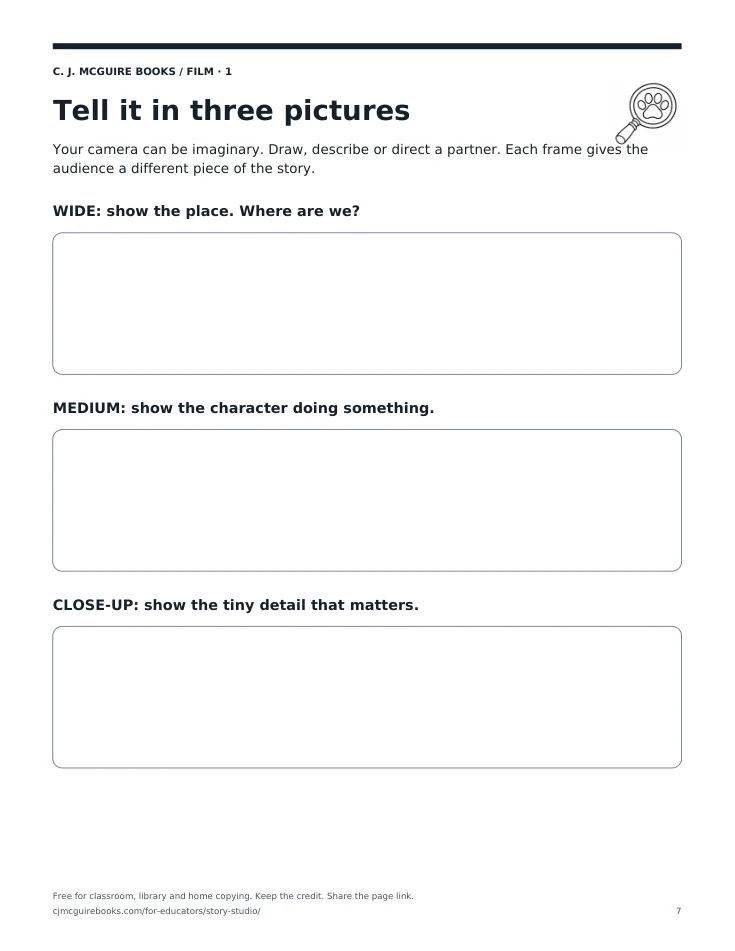
Fold a sheet into three spaces, or draw three boxes. Read the original setup aloud. Children can draw, dictate or direct your pencil.
- Show the place. A wide view might show a kitchen. Ask, “What tells the audience where we are?”
- Show the action. A medium view shows the cook peering into a container. What is the character doing?
- Show the important detail. A close-up reveals the sock and the basket handles. This was a laundry basket all along. That detail changes the story.
Give a partner the three pictures. Can they explain what happened? If they are confused, invite one useful change. Perhaps the handles need to be clearer. That is revision with a reason.
A small crew works
One child chooses the action, another draws, and another points to the pictures as an adult narrates. Share or switch jobs. Speaking in front of everyone is optional.
For a smaller step, sketch the first two frames together and offer a choice of final details. For more challenge, let children invent a different reveal and explain why the close-up belongs at the end.
You have practiced sequence, visual detail and a little audience awareness. The premiere can be one partner leaning over a desk. The red carpet is entirely optional.
A few useful details
Copy these original resources freely for noncommercial classroom, library and home use, including a closed class learning platform. Keep the credit and website link. To share publicly, link to the resource page. You do not need a C. J. McGuire book to use these activities.
How these resources were made
Creative direction is by C. J. McGuire. The resources were developed with AI assistance and are offered for educator review. They have not been independently evaluated or mapped to curriculum standards. The teaching notes describe intended practice, not promised outcomes.
The reading activities draw on principles such as modeling comprehension strategies and purposeful discussion. The IES guide to K–3 reading comprehension explains the evidence and its different strengths. It does not evaluate these resources.
Tell C. J. what worked, what needed help, or ask about a school or library reading → General observations are enough; please do not send children’s names, photographs or identifiable work.