
THE RESOURCE LIBRARY · 10 MINUTES · ONE CLEAN SOCK
A sock walks into your lesson. Suspicious.
From C. J. McGuire Books · K–2, with an adult
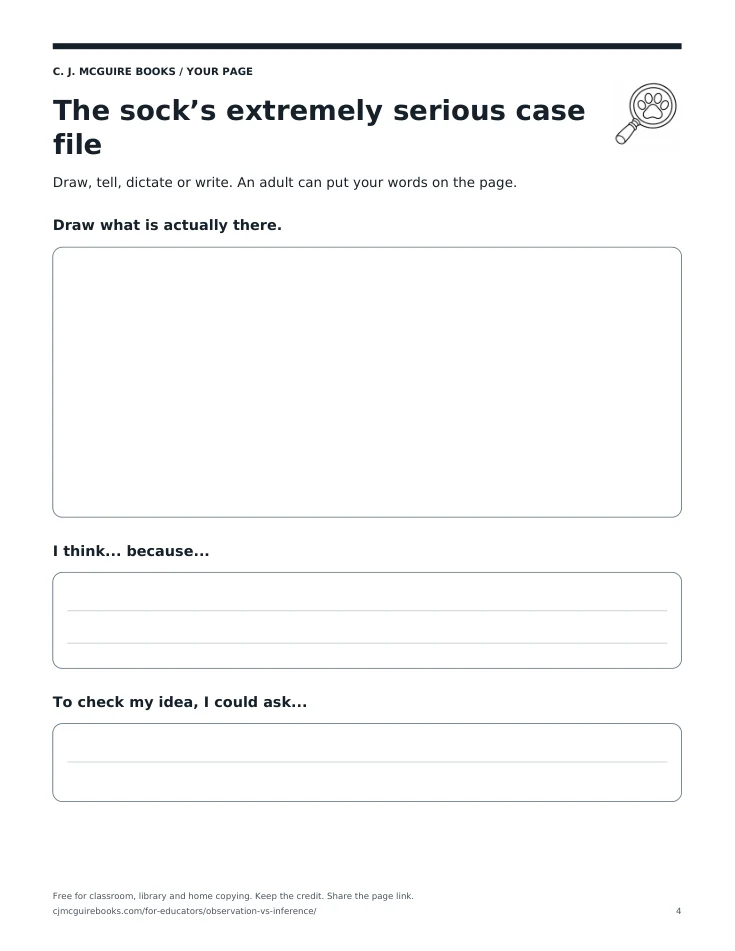
Place one clean sock on a chair, with a sheet of paper underneath it. Introduce your guest: “Extremely quiet. Excellent at sitting.” No child needs to touch it.
What do we actually know?
Ask children for something they can see. “There is one sock.” “The paper is underneath it.” Those are observations of the scene.
Now offer an explanation: “Someone may have left it there to dry.” We did not watch that happen. It is a possible inference, and we would need more information to check it.
Let the imagination have a turn
Invite a wonderfully ridiculous explanation. The sock has an appointment. The chair is its spaceship. It is waiting to give a very small concert.
Then ask, “Is that our pretend story, or do we have clues that make it likely?” Keep the invention and the evidence both welcome, with different jobs.
For the final two minutes, each child offers one observation and one possible explanation. Drawing, pointing, dictation and a partner’s help all count. If a child gives only a guess, ask which part of the scene helped them.
If you want a smaller start
Read two statements: “The sock is on the chair” and “The sock belongs to a giant.” Which can we establish just by looking? You are checking their reasoning, not whether they can pronounce “inference.”
The full guide adds six sorting cards and teacher answers. Today, the sock has already done a respectable amount of work. It can have the afternoon off.
A few useful details
Copy these original resources freely for noncommercial classroom, library and home use, including a closed class learning platform. Keep the credit and website link. To share publicly, link to the resource page. You do not need a C. J. McGuire book to use these activities.
How these resources were made
Creative direction is by C. J. McGuire. The resources were developed with AI assistance and are offered for educator review. They have not been independently evaluated or mapped to curriculum standards. The teaching notes describe intended practice, not promised outcomes.
The reading activities draw on principles such as modeling comprehension strategies and purposeful discussion. The IES guide to K–3 reading comprehension explains the evidence and its different strengths. It does not evaluate these resources.
Tell C. J. what worked, what needed help, or ask about a school or library reading → General observations are enough; please do not send children’s names, photographs or identifiable work.